

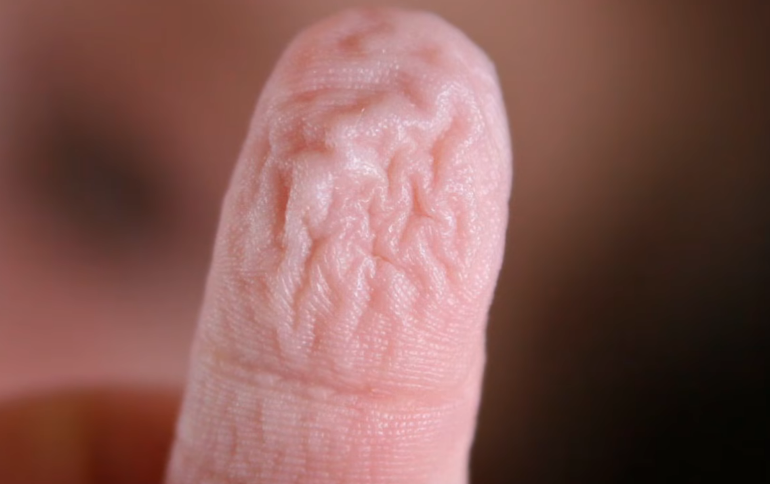
Those wrinkles after a bath aren’t simply your skin soaking up water. Research suggests your nerves and blood vessels actively help create them—and the response may have a surprisingly practical purpose.
The Real Reason Your Fingers Wrinkle in Water—and What Your Nerves Have to Do With It
There is a strange little transformation almost everyone has seen.
Stay in a bath for long enough and your fingertips begin to look completely different. The smooth skin becomes lined with ridges and valleys, giving your fingers that familiar “pruney” appearance.
It seems so ordinary that most of us never question it.
For years, the simplest explanation was that the outer layer of the skin absorbed water, became swollen and folded, much like a sponge.
But that explanation doesn’t tell the whole story.
Scientists have found that water-induced wrinkling involves the sympathetic nervous system, the part of the autonomic nervous system responsible for many automatic responses in the body. When the hands are immersed in water, blood vessels in the fingertips constrict, reducing the volume of tissue beneath the skin and helping create the characteristic wrinkles.
And that raises an even more interesting question:
Why would your body actively create wrinkles in the first place?
Your Fingers Aren’t Simply “Soaking Up” Water
The old explanation sounds logical. Put your hands in water and the skin gets wet, so perhaps it simply absorbs enough water to swell and wrinkle.
But experiments and physiological research have shown that the process is more complicated.
Water immersion triggers changes involving the skin, nerves and tiny blood vessels. Researchers have linked the wrinkling response to increased sympathetic nerve activity and vasoconstriction, meaning the small blood vessels in the fingertips narrow. As blood volume in the fingertip decreases, the tissue beneath the outer skin changes shape, pulling the surface into folds.
This also explains something that the simple “water absorption” theory cannot:
The response depends on functioning nerves.
Studies have found that damage to sympathetic nerve pathways can reduce or eliminate normal water-induced wrinkling.
So those little wrinkles are not just a cosmetic reaction.
They are evidence that several systems are interacting beneath the surface.
Could Pruney Fingers Actually Improve Your Grip?
This is where the story gets even more intriguing.
Researchers have proposed that the grooves created by water-induced wrinkling may help move water away from the contact surface, somewhat like the tread on a tire.
A 2013 study published in Biology Letters tested whether wrinkled fingers affected people’s ability to handle wet objects. Participants were asked to move objects under wet and dry conditions.
The researchers found that participants handled wet objects more efficiently when their fingers had developed water-induced wrinkles. The same advantage was not seen when handling dry objects.
The finding supports the idea that the wrinkles may have a functional role in wet environments.
Imagine trying to pick up a slippery object underwater. A smooth surface can allow water to remain between your skin and the object. Grooves may provide pathways for water to escape, potentially improving contact.
Scientists have therefore suggested that water-induced wrinkling could have offered an advantage for activities involving wet surfaces.
But it is important not to overstate the conclusion.
The grip study provides evidence of improved handling of wet objects; it does not prove that finger wrinkling evolved specifically for survival or that this was its original evolutionary purpose.
Your Autonomic Nervous System Is Doing More Than You Think
The most fascinating part may not be the wrinkles themselves.
It is the fact that you don’t have to think about creating them.
Your autonomic nervous system continuously regulates processes that operate largely outside conscious control, including heart rate, blood vessel diameter and digestion.
Water-induced skin wrinkling appears to involve this same automatic control system.
Researchers have described the response as a marker of sympathetic function, with vasoconstriction playing a major role in changing fingertip volume and producing the wrinkles.
That means something as trivial as soaking your hands can reveal a small glimpse of the nervous system at work.
When Wrinkling Becomes a Medical Clue
The phenomenon has also attracted interest in neurology.
Because normal water-induced wrinkling depends partly on intact sympathetic nerve pathways, clinicians have investigated the response as a simple supportive test of peripheral nerve function.
Research has found that reduced water-induced wrinkling can occur in people with certain forms of peripheral or small-fiber neuropathy. Studies have also examined its relationship with autonomic dysfunction.
However, this is where online health advice often goes too far.
Not having very wrinkly fingers after a bath does not automatically mean you have nerve damage, diabetes or a neurological disease.
The amount and speed of wrinkling can vary between people and can be influenced by factors including age and medical history. More recent research also shows that temperature, solution properties and other experimental conditions can affect how quickly wrinkling develops.
In other words, your fingers are interesting—but they are not a standalone diagnostic test.
What If Your Fingers Wrinkle Without Water?
That is a different situation.
Temporary changes in the appearance of the skin can have many explanations, and a persistent or unusual change should not be diagnosed from an internet article.
If your skin looks persistently wrinkled, changes color, becomes painful, develops swelling or is accompanied by numbness or other symptoms, it is reasonable to discuss it with a healthcare professional.
The same applies if you notice new changes in sensation, strength or circulation in your hands.
A Tiny Reflex With a Bigger Story
The next time you emerge from a bath and notice your fingertips have transformed into tiny landscapes of ridges and valleys, there is more happening than meets the eye.
Your skin isn’t simply behaving like a sponge.
Your nerves, blood vessels and surrounding tissues are participating in an automatic physiological response. Research suggests that the resulting grooves may even make it easier to handle wet objects.
It is a reminder that some of the body’s most ordinary behaviors are also its most fascinating.
The wrinkles disappear after you dry off.
But the biology behind them is remarkably sophisticated.