

Plastic has become so woven into everyday life that it can be easy to forget just how much of it surrounds us.
Food packaging, drinking containers, synthetic materials and other everyday products can gradually shed tiny plastic particles. Scientists are increasingly studying microplastics and nanoplastics because some of the smallest particles may behave differently inside the body from larger pieces.
That has created a surprising question: if some plastic particles enter the digestive tract, is there anything in the gut that can help keep them there long enough to be eliminated?
A new 2026 study offers an unusual clue.
Researchers at the World Institute of Kimchi investigated a lactic acid bacterium isolated from kimchi called Leuconostoc mesenteroides CBA3656. In laboratory experiments, the bacterium showed an ability to bind polystyrene nanoplastics. In simulated intestinal fluid, the strain maintained about 57% adsorption, and experiments in germ-free mice found substantially more nanoplastics in the feces of animals given the bacterium.
That does not mean eating kimchi removes plastic from the human body.
But it does point toward a fascinating area of research.
Why are nanoplastics getting so much attention?
Microplastics are generally defined as plastic particles smaller than 5 millimeters. Nanoplastics are even smaller—typically measured below 1 micrometer.
Their tiny size is important because researchers are investigating whether some nanoplastics can interact differently with biological barriers, including the intestinal lining.
Scientists have detected micro- and nanoplastic particles in human-related samples, but many questions remain about exactly what exposure levels mean for long-term health.
That uncertainty is especially important for older adults.
Aging can bring changes in digestion, intestinal function, immune responses and the gut microbiome. Many older adults also take multiple medications or live with chronic conditions, making it particularly important not to turn an emerging laboratory finding into a one-size-fits-all health recommendation.
The key issue is not simply whether plastic particles enter the body.
It is what happens to them afterward.
The surprising role of a fermented-food bacterium
The bacterium examined in the new study does not appear to “eat” or chemically digest the plastic.
Instead, researchers studied a process called biosorption.
In simple terms, particles attach to the surface of the bacterial cells.
The researchers found that L. mesenteroides CBA3656 could maintain substantial nanoplastic-binding ability under conditions designed to mimic the intestinal environment. The study suggests that chemical groups on the bacterial cell surface contribute to these interactions.
This distinction matters.
The bacterium is not turning plastic into harmless nutrients. It is acting more like a microscopic carrier or trap, potentially keeping some particles in the intestinal contents so they can leave the body in stool.
That is an interesting biological strategy because preventing a particle from interacting with the intestinal wall could, in theory, alter how much remains available for uptake.
But that possibility still needs to be demonstrated in people.
What happened in the mice?
The researchers moved beyond laboratory glassware and tested CBA3656 in germ-free mice.
These animals have been raised without the complex communities of microorganisms normally found in the gut. That makes them useful for studying a particular bacterial strain under controlled conditions, but it also makes them very different from ordinary humans.
When mice received CBA3656, researchers detected more than twice as much nanoplastic in their feces compared with controls.
That finding is important because it shows the bacterial binding effect was not limited to a test tube.
However, increased fecal excretion is not the same thing as proven health protection.
The study did not establish that the treatment prevents cancer, protects the brain or kidneys, reduces inflammation, or improves human health.
Those are separate questions that future research must answer.
Does this mean kimchi can remove plastic from your body?
Not yet.
This may be the most important point for anyone tempted by the headline.
The study tested a specific bacterial strain—CBA3656—rather than ordinary servings of kimchi.
Different kimchi products can contain different microorganisms depending on ingredients, fermentation conditions, storage and processing. A commercial product therefore cannot automatically be assumed to contain the same strain in the same quantity.
The researchers also focused on polystyrene nanoplastics. Real-world exposure involves many different plastic materials, and scientists do not yet know whether the same bacterial strain will bind all of them equally well.
So the research should be viewed as an early proof of concept, not a dietary prescription.
What older adults should take from the research
For older readers, the most useful message may actually be broader than kimchi.
The study highlights how little scientists still know about the relationship between environmental contaminants, the gut microbiome and aging.
It also demonstrates why nutrition research can sometimes produce surprising connections between traditional foods and modern health challenges.
Fermented foods can certainly be part of a varied diet, but there is no evidence that people should eat kimchi specifically to remove nanoplastics.
And anyone with a condition requiring a medically restricted diet should not make major dietary changes based on a single laboratory study.
The bigger question: can microbes become environmental defenders?
That may ultimately be the most interesting part of this discovery.
Scientists are increasingly exploring microorganisms as biological tools for environmental problems. Instead of trying to chemically destroy every contaminant, researchers can investigate whether microbes can capture, transform or otherwise interact with unwanted compounds.
The kimchi bacterium offers one example.
It does not solve the plastic problem. It does not prove that nanoplastics are causing a particular disease in humans. And it does not turn a traditional fermented food into a medical treatment.
What it does provide is a new scientific possibility: a food-derived microorganism may be able to physically capture certain plastic particles in the digestive tract and help move them toward elimination.
That is intriguing enough to deserve further study.
For now, however, the best interpretation is a cautious one.
The jar of kimchi on the refrigerator shelf is not a proven plastic-cleansing medicine.
But somewhere inside the microscopic world of fermentation, scientists may have found a biological trick worth investigating.
And as plastic exposure becomes an increasingly important environmental-health question, that tiny discovery could lead to some very big questions about the relationship between food, microbes and the contaminants of modern life.
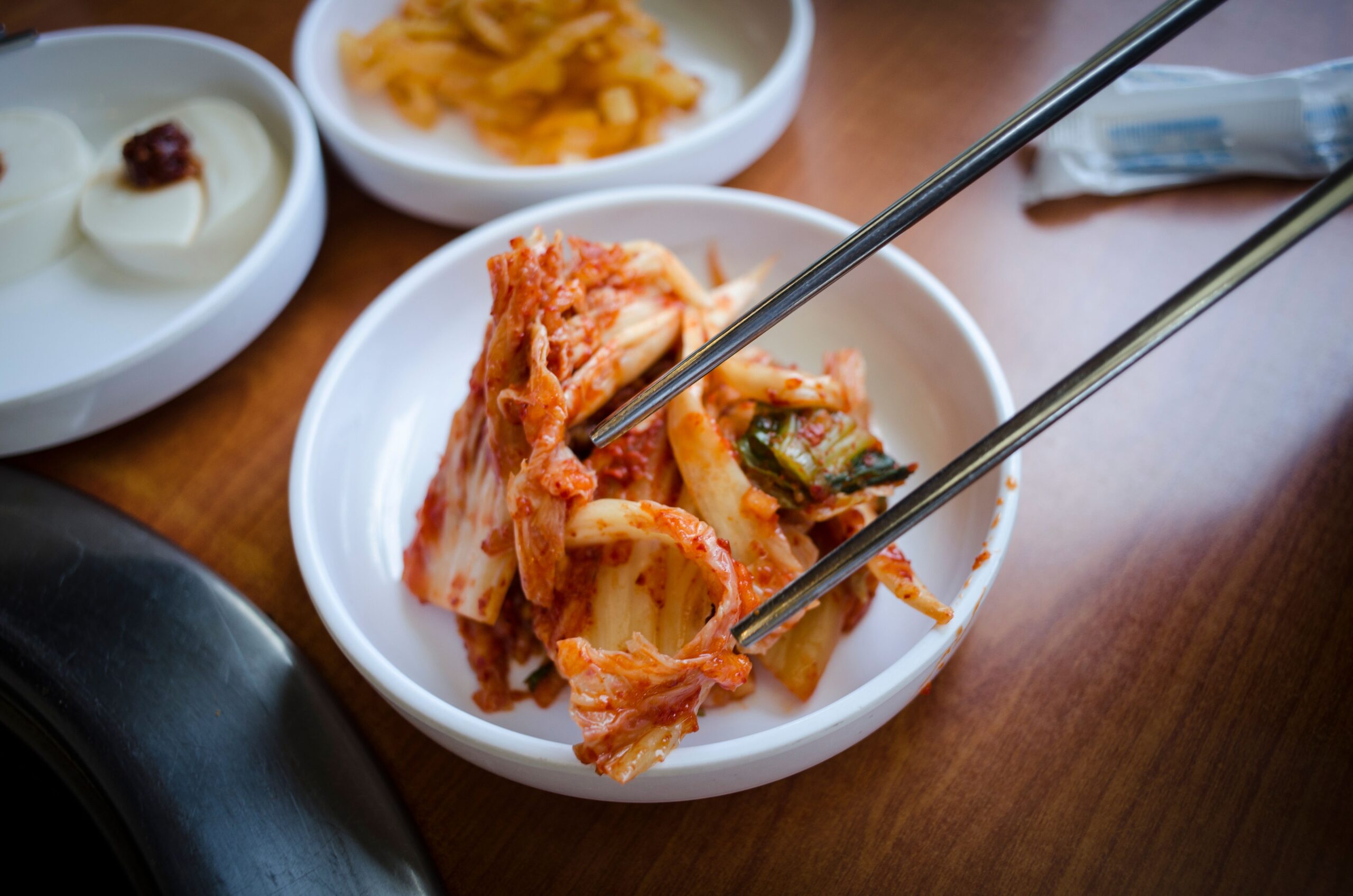
Photo by makafood: https://www.pexels.com/photo/kimchi-in-white-ceramic-bowl-8838806/