
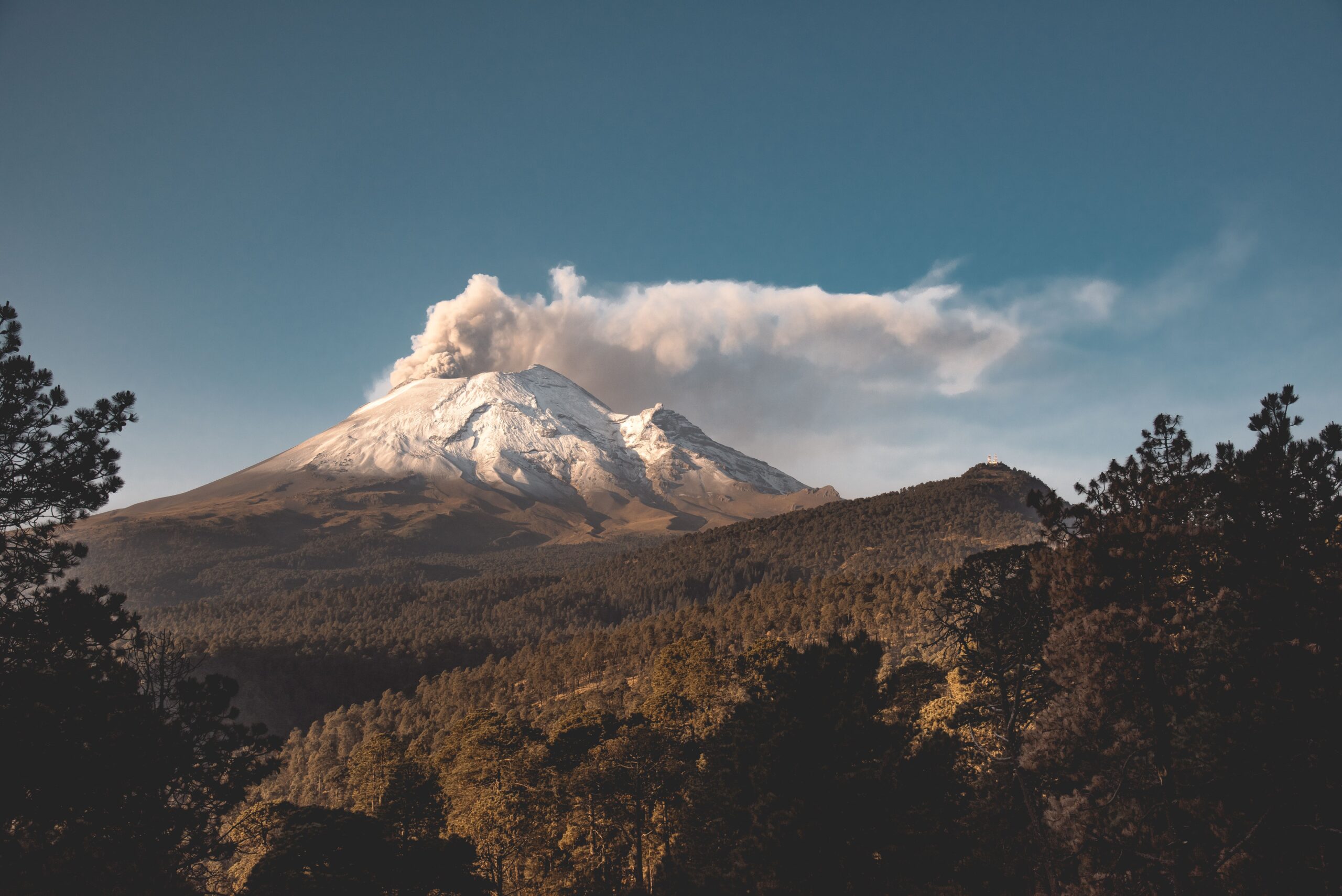
Imagine looking at a mountainside and seeing nothing unusual.
No dramatic plume. No earthquake strong enough to wake anyone. No river of lava.
Just trees.
Yet those trees may sometimes respond to subtle changes taking place beneath their roots—and scientists are investigating whether those biological responses could provide another piece of information when monitoring restless volcanoes.
It sounds almost like science fiction: could a forest reveal something about a volcano before people can see it?
The answer is more complicated than a simple yes.
Researchers have found that volcanic carbon dioxide can influence ecosystems around active volcanic systems. At Mammoth Mountain in California, for example, scientists used airborne remote sensing alongside ground measurements of soil CO₂ and found that elevated volcanic CO₂ was associated with measurable changes in canopy greenness, nitrogen and water use.
But there is an important distinction.
A greener forest is not currently a dependable countdown clock for an eruption.
Instead, vegetation observations represent one promising research tool within a much larger system of volcano surveillance.
The Hidden Gas Beneath the Trees
Volcanoes release gases from magma beneath the surface. Carbon dioxide is one of the gases scientists monitor because it can escape through soil and fractures around volcanic systems.
That creates an unusual relationship between geology and biology.
Roots and vegetation can respond to changes in their environment. Where volcanic CO₂ reaches the soil, it can alter the conditions experienced by plants.
At sufficiently high concentrations, however, volcanic CO₂ can become dangerous to plants and people alike. Heavy concentrations can accumulate in low-lying areas and displace oxygen.
For scientists, that creates something worth studying: can changes in vegetation help reveal where volcanic gases are moving?
Research from Mammoth Mountain suggests there is a detectable ecological signal. Scientists found that soil CO₂ flux could help predict characteristics such as canopy greenness and evapotranspiration.
That is intriguing—but it does not mean every burst of green vegetation signals an approaching eruption.
Rainfall, temperature, drought, soil conditions and seasonal changes can all affect vegetation.
That is why researchers need multiple independent measurements before interpreting a biological anomaly as evidence of volcanic unrest.
Satellites Are Changing the Way Volcanoes Are Watched
This is where the story becomes especially interesting.
Scientists no longer have to depend entirely on teams physically climbing dangerous volcanic slopes to understand what is happening.
Satellites can repeatedly observe volcanic landscapes from space.
In 2026, USGS researchers described major advances in satellite-based volcano monitoring, including the use of radar and other Earth-observation data to detect deformation and periods of volcanic unrest. Their work contributes to a broader effort to build more comprehensive global satellite monitoring and early-warning capabilities.
Satellite imagery can reveal changes that are difficult to see from the ground, including alterations in surface temperature, ground deformation and vegetation.
That does not make satellites a replacement for traditional monitoring.
Instead, the future is increasingly about combining many clues.
A volcano might show unusual ground movement in radar data, increased seismic activity, changes in volcanic gases and thermal abnormalities. Vegetation observations could potentially add another environmental signal.
The more independent pieces of evidence scientists have, the better they can understand what a volcano is doing.
Why This Matters for Older Adults
For most people, volcano monitoring may sound like a geological curiosity.
But it is also a public-health issue.
Volcanic eruptions can produce ash and gases capable of irritating the eyes and respiratory tract. CDC identifies older adults and people with asthma, emphysema and other chronic respiratory conditions as groups that may have greater difficulty when exposed to volcanic ash.
That makes advance information particularly valuable.
Imagine an older person living in a community downwind of an active volcano.
A warning may give them time to collect prescription medications, arrange transportation, contact family members, secure important documents and prepare a place to stay away from the affected area.
For someone who uses oxygen, relies on regular medical treatments or has limited mobility, evacuation planning can be particularly important.
The benefit of improved monitoring isn’t simply knowing that a volcano is becoming restless.
It is having more time to make sensible decisions before conditions become dangerous.
The Health Threat Isn’t Just Lava
Volcanic danger is often pictured as glowing lava flowing down a mountainside.
In reality, communities can face several hazards.
Ash can travel considerable distances and may irritate the lungs. Volcanic gases can also cause health problems, while eruptions can trigger landslides, mudflows, flooding and other hazards.
For people with chronic respiratory disease, ash can be particularly troublesome.
During volcanic ashfall, CDC recommends staying indoors when possible, keeping windows and doors closed and following local authorities’ instructions. If people must go outside or clean up ash, a NIOSH-approved N95 respirator can help reduce inhalation of particulate ash.
But an N95 does not make it safe to ignore an evacuation order.
When authorities tell residents to leave, evacuation instructions take priority.
Don’t Wait for the Trees
Perhaps the most important correction to the popular version of this story is also the simplest:
Don’t watch the trees for your personal eruption warning.
A greener mountainside cannot tell an individual resident that an eruption is about to happen.
Volcano forecasting is complicated, and warning systems depend on professional monitoring and interpretation of multiple signals.
The real promise of vegetation research is scientific.
If plants can reveal environmental changes associated with volcanic CO₂, researchers may eventually be able to incorporate that information into broader monitoring systems. It could help scientists understand where volcanic gases are moving or identify areas that deserve closer investigation.
That is very different from saying that a forest can predict an eruption months in advance.
A New Kind of Volcano Monitoring
There is something wonderfully humbling about the idea.
For generations, scientists have built increasingly sophisticated instruments to listen to volcanoes. Now they are also learning how to interpret signals coming from the living landscape surrounding them.
Trees cannot predict the future.
But they may respond to changes that scientists cannot easily see.
Combined with satellites, seismic instruments, radar, gas measurements and ground observations, those biological responses could become another piece of the puzzle.
And for older adults living near volcanic regions, the most meaningful development isn’t whether a forest can whisper the exact moment a mountain will erupt.
It is whether better science can provide earlier, clearer information—enough time to protect the people who may need it most.
Sometimes the most important warning isn’t a dramatic eruption in the distance.
It is the quiet accumulation of clues that tells scientists to look closer.
Photo by Irving Joaquin Gutierrez : https://www.pexels.com/photo/volcano-and-forest-17172502/