

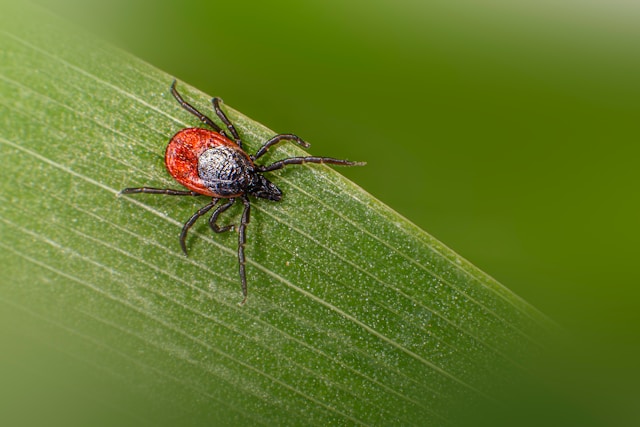
A Long Island man got sick after removing two ticks from his leg in 2021. Doctors only confirmed what actually made him ill this year — because no standard lab test exists for the virus that did it.
Michael Larkin was doing yard work in his backyard in Shirley, New York, when he noticed two small ticks on his leg. He pulled them off and didn’t think much more of it — until, a few days later, he started feeling seriously unwell.
That was 2021. It took until this year for doctors to know exactly what had made him sick.
“There are a lot of lone star ticks in New York… the Bourbon virus is likely more prevalent than we think.” — Dr. Luis Marcos, Stony Brook Medicine
Researchers at Stony Brook Medicine, led by Dr. Luis Marcos, director of the university’s Tick-Borne Diseases Clinic, confirmed this year that Larkin’s illness was New York State’s first documented human case of Bourbon virus — a rare and potentially serious tick-borne infection with no approved vaccine, no targeted antiviral treatment, and, critically, no standard commercial lab test available anywhere in the country. Marcos and his team only identified the case by going back through blood samples from 107 patients who’d shown up at Stony Brook between 2019 and 2024 with fever and tick-bite symptoms that hadn’t responded to the usual treatment. Larkin’s case stood out specifically because he’d gotten worse, not better, on standard antibiotics — a strong clue that something other than a bacterial tick-borne illness was behind it. He was ultimately hospitalized with severe symptoms before recovering.
That five-year gap between infection and diagnosis is really the heart of this story. Bourbon virus, first identified in 2014 in Bourbon County, Kansas, is caused by an RNA virus in the Thogotovirus genus, spread primarily by the lone star tick. Unlike Lyme disease or anaplasmosis — both caused by bacteria that respond to doxycycline — Bourbon virus is a virus, and antibiotics do nothing for it. Its early symptoms, though, look almost identical to those more familiar tick-borne illnesses: fever, exhaustion, headache, body aches, nausea, and sometimes a rash, often alongside lab results showing low white blood cell and platelet counts. Without a specific test to distinguish it, a patient with Bourbon virus can easily get treated, and cleared, for the wrong illness — which is exactly what appears to have happened in Larkin’s case for years.
This isn’t the very first sign of the virus in New York, either. Back in 2019, researchers had already detected Bourbon virus RNA in a tick pulled off a different Long Island resident, and a broader survey of white-tailed deer in Suffolk County found evidence the virus was already circulating locally. What changed this year is that a human case was finally confirmed and formally documented — evidence that the virus isn’t just present in the region’s tick population, but has already been making people sick. Nationally, the virus remains rare, but not harmless: two U.S. deaths have been linked to it since its discovery, one in 2014 and one earlier this year.
The bigger context here is the lone star tick itself, which has been steadily expanding its range northward for years, helped along by milder winters and growing deer populations. Populations are now established across all of Long Island and much of southern New England — a region where tick-borne disease prevention has historically focused almost entirely on the blacklegged tick and Lyme disease. Beyond Bourbon virus, lone star ticks are also known to carry Heartland virus and to trigger alpha-gal syndrome, a delayed allergic reaction to red meat caused by a molecule in the tick’s saliva.
None of this means panic is warranted — Bourbon virus infections remain genuinely rare, and most tick bites in the Northeast still carry a far higher risk of Lyme disease than anything else. But Marcos’s own point is worth taking seriously: because doctors can’t easily test for it, milder cases are almost certainly being missed and misattributed to more familiar illnesses.
The practical takeaway hasn’t changed much, even if the risk landscape has expanded. Use an EPA-registered repellent containing DEET or picaridin when spending time in grassy or wooded areas, treat outdoor clothing and gear with permethrin, and do a full-body tick check — followed by a shower within two hours — after any time outdoors. And if you develop a sudden high fever, unusual fatigue, or body aches after a tick bite, especially if standard antibiotics don’t seem to be helping, tell your doctor about the exposure specifically. It’s the detail that made the difference, eventually, in figuring out what was wrong with Michael Larkin.
Photo by Erik Karits on Unsplash