

Leprosy sounds like a disease that belongs in a history book.
For centuries, people with the condition were often feared, isolated and misunderstood. The word itself became associated with permanent disability and social exclusion.
But Hansen’s disease, the modern medical name for leprosy, never disappeared.
It still occurs in the United States, including Florida, where health officials and researchers have been paying particular attention to locally acquired cases.
Florida reported 36 cases in 2025, according to the figures cited in recent reporting, while cases have continued to be identified in 2026. Central Florida has emerged as an important geographic focus.
A CDC investigation found that Central Florida accounted for 81% of Florida’s reported cases in the study period and almost one-fifth of cases reported nationally. Researchers also found that many patients did not have the international travel history traditionally associated with Hansen’s disease.
That finding raises an intriguing question:
If people are becoming infected locally, where is the bacterium coming from?
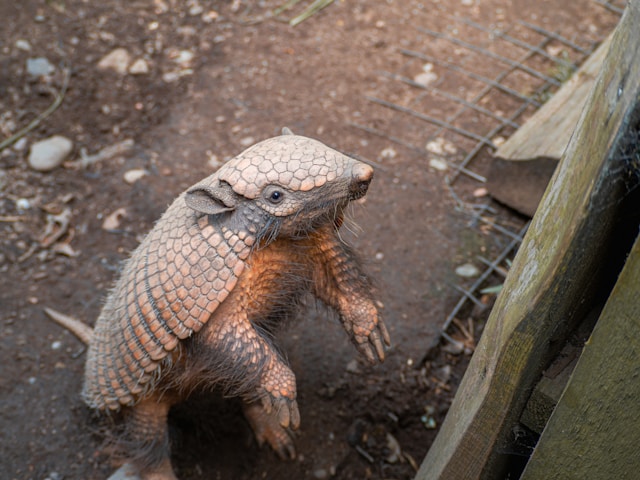
One possible answer has four legs, a shell-like coat and a habit of digging through Florida soil.
The Armadillo Connection
Nine-banded armadillos are unusual among animals because they can naturally carry Mycobacterium leprae, the bacterium that causes most cases of Hansen’s disease.
Scientists have found genetic similarities between strains of M. leprae found in armadillos and strains identified in some human infections in the southern United States. That provides evidence that transmission from armadillos to humans can occur.
But there is an important distinction between possible transmission and common transmission.
Encountering an armadillo does not mean you are likely to develop leprosy. The CDC considers the risk from armadillos to be very low.
For most people, simply seeing one in a yard or walking past one outdoors is not a health emergency.
The sensible approach is much simpler: don’t handle wild armadillos, and avoid unnecessary contact with them.
What About Contaminated Soil?
This is one of the more interesting—and less settled—parts of the story.
Because armadillos spend considerable time digging and foraging in soil, researchers have questioned whether environmental exposure could play a role in some infections.
Scientists have detected M. leprae in environmental settings and are investigating whether soil could serve as a reservoir under certain circumstances. However, environmental transmission is not established as a common way people acquire Hansen’s disease.
That distinction matters.
It would be misleading to tell Florida residents that ordinary gardening or touching soil is a proven route of infection.
Research is still trying to determine how much of a role the environment may play.
Why Hansen’s Disease Can Hide for Years
One of the strangest features of Hansen’s disease is its extraordinarily slow progression.
Unlike infections that can make someone seriously ill within days, M. leprae develops very slowly. The incubation period can be several years and, in some cases, considerably longer.
That means a person may have no obvious symptoms for a long time after exposure.
When symptoms eventually appear, the disease primarily affects the skin and peripheral nerves—the nerves outside the brain and spinal cord.
One of the most important warning signs is a persistent patch of skin that has reduced or completely lost sensation.
The patch may appear lighter, darker or reddish compared with the surrounding skin.
Other possible symptoms include numbness, tingling, weakness and thickened peripheral nerves.
The key clue isn’t necessarily what the patch looks like.
It is what the person can—or cannot—feel.
Why Nerve Damage Is the Real Concern
Hansen’s disease is often remembered for its historical association with severe physical deformities.
But the bacterium does not simply make body parts “fall off,” as an old myth suggests.
The major problem is nerve damage.
When nerves lose their ability to transmit normal sensation, a person may not notice pain from a cut, burn or other injury. Repeated injuries can then become infected or cause permanent tissue damage.
If nerve involvement is recognized early, treatment can help prevent these complications.
That is why a persistent numb skin patch should not simply be ignored.
The Reassuring Part of the Story
The word “leprosy” can make the disease sound terrifying.
Modern medicine tells a very different story.
Hansen’s disease is curable.
Treatment involves combinations of antibiotics, and early treatment is particularly important because it can stop the infection and reduce the risk of progressive nerve damage.
The disease is also much less contagious than many people assume.
You do not ordinarily contract Hansen’s disease from briefly sitting next to someone, shaking hands or having a casual conversation.
According to the CDC, transmission generally requires prolonged, close contact with an untreated person, with respiratory droplets thought to be an important route.
The CDC also estimates that about 95% of people have natural immunity to the disease.
So although Florida’s cases deserve scientific attention, they do not represent a reason for the average person to fear everyday contact with other people.
What Florida Residents Can Actually Do
There is no need to turn daily life into a campaign against soil, gardens or wildlife.
A few sensible precautions are enough.
Don’t handle wild armadillos. Even if an animal appears calm or harmless, wildlife should be left alone.
Protect your hands while gardening. Gloves are a practical way to protect your skin from cuts, scratches and contact with soil.
Wash your hands after outdoor work. Basic hand hygiene is useful after handling soil, mulch or other outdoor materials.
Pay attention to unexplained numbness. A persistent skin patch that has reduced sensation deserves medical evaluation, particularly if you live in an area where locally acquired Hansen’s disease has been reported.
And if you have had significant exposure to armadillos or have spent considerable time outdoors, mention that history to your healthcare provider.
Don’t Let the Stigma Return
Perhaps the most important part of Florida’s leprosy story has nothing to do with armadillos.
It is about stigma.
Hansen’s disease has carried an enormous social burden for thousands of years. Fear has often been worse than the medical reality.
Today, the disease can be diagnosed and treated.
A person with Hansen’s disease is not someone who needs to be feared or shunned.
At the same time, Florida’s locally acquired cases are scientifically important. They suggest that researchers need to continue studying the relationship between people, wildlife and the environment in areas where the disease appears to be occurring without international travel.
The mystery is not that an ancient disease has suddenly returned from the dead.
It is that a disease we understand reasonably well may still have parts of its transmission story that we haven’t completely solved.
For Florida residents, the message is straightforward: don’t panic, don’t handle wild armadillos, protect your skin during outdoor work, and don’t ignore unexplained numbness or persistent skin changes.
Awareness is far more useful than fear.
Photo by Aleksi Partanen on Unsplash